
Home / Crossed-out figure
The crossed-out figure on a Chinese listing and what it claims
A struck-through number is a statement about some other price. This page takes the price block apart, names the labels that sit beside the old figure, and shows what you need to note down to test it.
Where the struck-through number sits
On a desktop listing from Taobao, Tmall or JD, the price block usually sits to the right of the main photo, just under the title. On the phone version it is the first thing under the photo carousel. Either way the layout is similar: a large current price in red or orange, a smaller grey figure with a line through it, and sometimes a short label such as 原价, 吊牌价 or 日常价 in front of the grey figure. A campaign banner may sit above all of it with an end time.
Weidian, where many catalogue finds come from, is plainer. The listing we opened on 19 October 2026 (a printed T-shirt) showed one price, ¥119, with a sales count of zero and no struck figure. So a missing comparison figure is normal and tells you nothing bad; it simply means the seller is making no claim about a previous price.
The struck figure also follows the option you pick. Change the size or colour and both numbers can change, which is why a record only makes sense for one version of one listing.
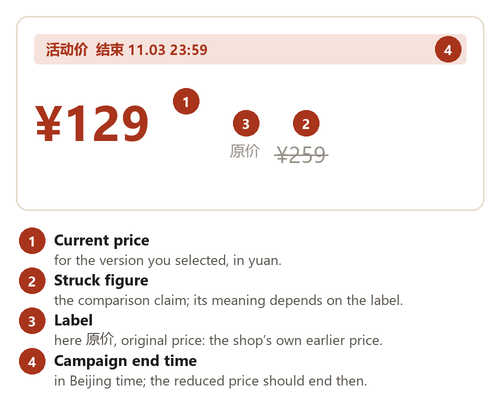
Tag price, counter price and daily price beside the old figure
The short word in front of the struck figure is the nearest thing to a definition you will get from the page, so it is worth reading literally.
- 吊牌价 (tag price): the figure printed on the swing tag. It says what the tag reads, not what anyone paid.
- 专柜价 (counter price): what a department-store counter charges for the same product. You cannot check it from a listing.
- 建议零售价 or 厂商指导价 (suggested or guide retail price): set by the maker. Chinese rules require it to be labelled as such.
- 日常价 (everyday price): the price outside campaigns. This one is a claim about the shop’s own past prices, so your record can test it.
- 原价 (original price): the plainest claim of all, that this was the shop’s own earlier price. Your record can test it.
- 参考价 (reference price): deliberately vague; it commits the seller to very little.
- 活动价 or 促销价 (campaign or promotion price): the current figure during an event. Look for an end time near it.
- 清仓价 (clearance price): a label for the current figure, not for the old one.
What the platform’s own price note says
Big Chinese marketplaces publish a short “price note” (价格说明) on item pages that explains the struck figure. In practice the note lists several things the figure might be: a counter price, a tag price, a retail price supplied by the maker, a manufacturer’s guide price, or a price the item was shown at earlier on the platform. It then says the figure is not the original price and is for reference only.
We tried to read the current wording on 19 October 2026 and could not: on Taobao and Tmall every item page we opened asked us to sign in first, and a JD item page returned a traffic-control page instead of the item. So we are not quoting the note here, only describing what it usually covers.
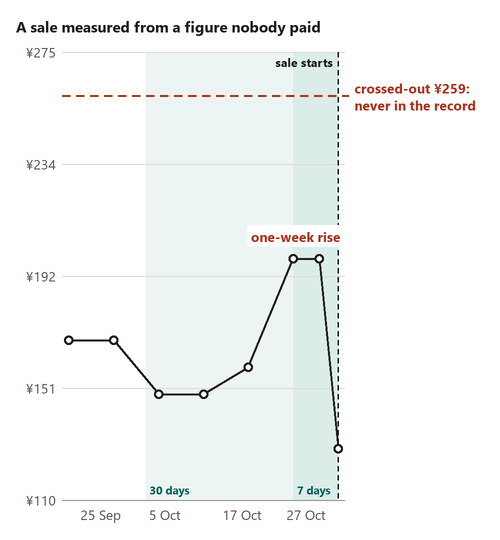
The practical point does not depend on the exact wording. A note that allows five meanings at once tells you nothing about which one applies to the listing in front of you. China’s 2022 price-marking rule expects a comparison price to be true and accurate, and where its details are missing it caps the figure at the seven-day low. Your own record is the only way to see which side of that line a listing falls on.
Discounts that start from a figure nobody paid
A reduction is only as real as the price it is measured from. The guidance from regulators in China, the EU and the UK keeps coming back to the same few ways that starting price can be hollow:
- A tag nobody pays. A swing-tag or suggested price that no shop actually charges makes any discount look large.
- A rise just before the event. China’s 2022 rule forbids a temporary, marked increase in the shown price right before a discount when there is no good reason for it, and the UK regulator lists short-lived price hikes among its examples of misleading claims.
- A price shown but not sold. The British regulator’s examples include a higher price at which very few items were sold; China’s default base is a transaction price, not a displayed one.
- An old price. A figure last charged months ago no longer says much about today’s value; both the British guidance and the EU thirty-day window are built to stop that.
None of these can be seen on a single visit. They show up only when you have looked at the same listing on several dates, which is the whole case for keeping a record.
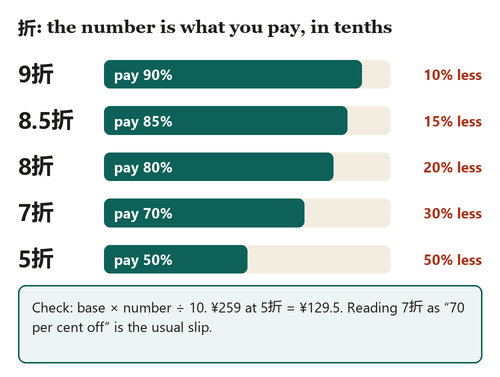
Reading 折 and percentages without flipping them
Chinese listings often state a discount with the character 折 (zhe), and it runs the opposite way from an English “percent off”. The number in front of 折 is the share you pay, in tenths: 7折 means you pay seven tenths of the base, a 30 per cent reduction. 8.5折 is a 15 per cent reduction, and 5折 is half price.
English readers sometimes take 7折 for “70 per cent off” and expect a price far lower than the seller is offering. The quick check is to multiply the base by the number and divide by ten: a 259 yuan base at 5折 is 129.5 yuan. If the page shows that result as the current price, the 折 figure is consistent with the struck figure; whether the struck figure itself is fair is a separate question.
Chinese rules use two words for cuts: 折价 for a cut stated as a ratio and 减价 for a cut stated as an amount. The seven-day base applies to both.
Keeping your own record of a listing’s price
A useful record is short. For each visit, note:
- the date, and the time if a campaign is running (the seller works in Beijing time, UTC+8);
- the listing address or item number, so you are sure it is the same listing next time;
- the version you would buy, written the way the page writes it;
- the large current price for that version, in yuan;
- the struck figure and the label in front of it, if there is one, plus any campaign end time.
Take a screenshot of the price block as well; it settles arguments with yourself later. Several dated visits can reveal differences between observed prices and a crossed-out figure. Gaps between visits mean the chart cannot establish every price in the period, the lowest transaction price or compliance with a seven-day or thirty-day rule.
Images: catalogue photographs are category examples, not this site’s purchases or verified Mulebuy orders. Drawn material, dimension and lettering examples explain a concept; they do not certify the depicted product.