
Home / Price after the link
Between the link and the purchase: price moves and the currency layer
Two things change the figure you pay after you have read a listing: the seller’s own price can move before the agent buys, and the agent shows your yuan in another currency at a rate it chooses.
When the seller’s price moves after you submit
An agent does not buy the moment you press submit. Its buyers work in Beijing business hours, check the listing, and then pay the seller. In that gap a campaign can end, an option can sell out, or the seller can edit the price.
Mulebuy’s terms, as archived in August 2026, said that if an item was out of stock or the price had changed, it would tell the buyer by station letter, its internal message system. Its FAQ of the same month explained that some orders needed an extra balance payment after submission because the seller’s price had changed, mostly on domestic delivery.
Agents trading today work the same way. LoongBuy’s help page on service timing, read on 19 October 2026, says that when an order needs your confirmation or an additional payment because of a price difference, its buyer usually completes the purchase within 24 hours after you confirm or pay. It also says orders paid between 09:00 and 18:30 Beijing time usually get a first response within seven hours.
Why the agent’s page and the seller’s page can disagree
Three prices can be in front of you at once: the figure on a catalogue card, the figure on the marketplace listing, and the figure on the agent’s order page. They are read at different moments. The card may be hours or days old, the agent’s page reads the listing when you paste the link, and the listing itself changes whenever the seller edits it or a campaign starts or ends.
Domestic shipping adds a second moving part. Many listings include delivery inside China, others charge it separately, and that charge can change with the seller’s courier. Some displayed prices also depend on the buyer’s own account; that is a different subject from the crossed-out figure and we leave it aside here.
The habit that helps is the same as before: write down the listing price for your version on the day you submit, and compare it with what the agent asks for if a balance request arrives.
Display currency laid over the seller’s yuan
Every price in this chain starts in yuan. The seller sets it in yuan, the agent pays it in yuan, and the agent then shows it to you in dollars, euros or pounds by applying its own exchange rate. That rate is the agent’s choice, and it can sit some way from the reference rates published by central banks.
Agents describe this differently. LoongBuy’s fee page, read on 19 October 2026, says yuan is the underlying currency for settlement and refunds and that other currencies are converted and displayed “using the applicable exchange rate”, without naming a reference. OOTDBuy’s top-up page says the amount, the settlement currency, the settlement rate and the spread are shown before you top up. When you compare a reduced price across agents, compare it in yuan first.
Mulebuy’s archived rate table against the euro reference
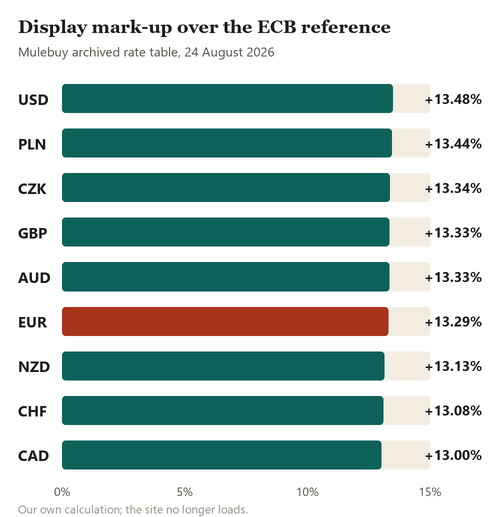
Mulebuy published a currency table that its site used to convert yuan prices. We compared the copy archived on 24 August 2026 with the European Central Bank’s reference rates for the same day. On that day Mulebuy showed 1 euro as 6.9217 yuan, while the reference rate put 1 euro at about 7.84 yuan. Put the other way round, a yuan price displayed in euros came out 13.29 per cent higher than the reference rate would give.
Every currency in the table sat in the same band. Our own calculation from the archived table gives these mark-ups over the reference rate on 24 August 2026: US dollar 13.48 per cent, pound 13.33, Polish zloty 13.44, Canadian dollar 13.00, Australian dollar 13.33, Swiss franc 13.08, Czech koruna 13.34 and New Zealand dollar 13.13.
Mulebuy’s own pages described the rate in two ways. Its top-up help pointed to rates the Bank of China publishes; its terms said payments used the rate displayed by the platform at the time of payment. The archived table is what buyers were actually shown, and it was neither close to the reference rates nor stated as a mark-up anywhere we could see. This is a record of August 2026; the site no longer loads.
A converted crossed-out figure inflates the saving, not the percentage
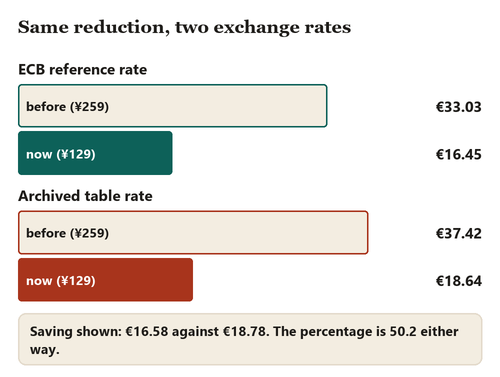
Currency mark-ups do something quiet to a reduced price. Take a listing at 129 yuan with 259 yuan struck through. At the reference rate of 24 August 2026 that is about €16.45 now and €33.03 before, a saving of €16.58. Through Mulebuy’s archived table it would have shown as €18.64 and €37.42, a saving of €18.78.
The percentage is the same either way, 50.2 per cent, because both numbers are scaled by the same rate. What grows is the amount of money the page says you are saving, and it grows by the full mark-up. A bigger converted saving is not a better deal; it is the same deal measured with a stretched ruler.
So keep two rules. Judge the reduction in yuan or in percentages, which travel across currencies unchanged. And judge the final cost in your own currency at a reference rate you trust, adding the agent’s fees and shipping on top.
Keeping the price record in yuan
The Look-back chart takes yuan for that reason. Type the figure the seller shows, not the agent’s converted one, and the two reference lines will mean what the rules mean. If you only have a converted figure, convert it back with the rate the agent showed on that day, or leave that entry out rather than mixing currencies in one record.
At the end, when you have decided to buy, convert the final yuan total once, at a reference rate, and compare it with what the agent will actually take from your card. The difference is the agent’s currency margin, and it is worth knowing even when it is small.
Images: catalogue photographs are category examples, not this site’s purchases or verified Mulebuy orders. Drawn material, dimension and lettering examples explain a concept; they do not certify the depicted product.