
Home / China rules
China’s rules for comparison prices, read from a buyer’s side abroad
Three sets of national rules decide what a reduced price in a Chinese listing should be measured against. We read each one on an official government site on 19 October 2026; the translations below are our own.
Article 21 of the promotion rules of 2020
The 《规范促销行为暂行规定》, the interim rules on promotional conduct, were issued as Order No. 32 of the State Administration for Market Regulation on 29 October 2020 and took effect on 1 December 2020. Chapter four deals with price promotions. Article 20 requires any conditions to be clearly marked and any time limit on a reduced price to be shown. Article 21 is the one that matters here.
经营者折价、减价,应当标明或者通过其他方便消费者认知的方式表明折价、减价的基准。未标明或者表明基准的,其折价、减价应当以同一经营者在同一经营场所内,在本次促销活动前七日内最低成交价格为基准。
Article 21, SAMR Order No. 32 (2020), as published on samr.gov.cn and moj.gov.cn, read 19 October 2026
In plain terms: a seller who cuts a price by a ratio or an amount must show the base. If it does not, the base is the lowest price at which that same seller actually sold, in the same place of business, during the seven days before this promotion. The article goes on to say that if there were no sales in those seven days, the last transaction price before the promotion is the base.
Two words do a lot of work. “Transaction” (成交) means a sale, not a displayed price. “Same place of business” means the shop that runs the promotion, not the same item elsewhere.
The price-marking rule of 2022 and the comparison price
The 《明码标价和禁止价格欺诈规定》, rules on clear price marking and the prohibition of price fraud, are Order No. 56 of the same regulator, issued on 14 April 2022 and in force from 1 July 2022. They replaced two older rules from 2000 and 2001. Three articles bear on a crossed-out figure.
- Article 16. Information about a comparison price (被比较价格) must be true and accurate. Where the seller gives no details of the comparison price, it may not be higher than the seller’s lowest transaction price in the same place of business during the seven days before the comparison; with no sales in that time, not higher than the last transaction price. A comparison with a manufacturer’s suggested retail price must say so clearly and be updated as soon as that price changes.
- Article 17. Without a reasonable cause, a seller may not temporarily and markedly raise its shown price just before a discount and then use that figure as the base. Nor may it use a price with no basis, or one that cannot be compared, as the base or the comparison price.
- Article 19. Selling through false discounts, false price cuts or false price comparisons is listed as price fraud, alongside misleading wording, figures or images used to show prices.
Article 21 of the same rules sets out when conduct is not treated as price fraud: where the seller can show it had no intent, where the actual price gives the buyer a bigger reduction than shown, and where a small mismatch comes from normal rounding.
Online shops and platforms under the 2026 platform price rules
The 2022 rules already had an article for online sellers. Article 20 bars a lower price on a home page or other prominent spot than on the item’s detail page, and promotion rules that differ from what actually applies; it also bars platforms from forcing their shops into false or misleading price marking.
On 9 December 2025 the National Development and Reform Commission, the market regulator and the Cyberspace Administration issued the 《互联网平台价格行为规则》, rules on price conduct by internet platforms (document 发改价格规〔2025〕1607号). They took effect on 10 April 2026 and run for five years. For a reduced find, three articles count:
- Article 10: a price promotion must show its rules, period and scope in a prominent place, and the base of a discount or price cut must be marked truthfully.
- Article 18: repeats the list of price fraud, and adds faking, altering or deleting records of actual online transaction prices.
- Article 19: a platform may not show a lower price on its home page than on the detail page, or run a promotion whose real scope differs from the one it announced.
The text we read is the notice on the NDRC’s official information-disclosure site, checked on 19 October 2026.
What the same shop and the same seven days look like from outside
The rules are written from the inside: they talk about the seller’s own transactions, which only the seller, the platform and a regulator can see. A buyer abroad sees something narrower.
You see the displayed price for the version you select, on the day you look. You may see a sales count, usually rounded and covering a longer period. You do not see what the last buyer actually paid after any discount that applied to their account. So your record measures displayed prices, and the lowest displayed price is a reasonable stand-in for the seven-day base rather than the base itself.
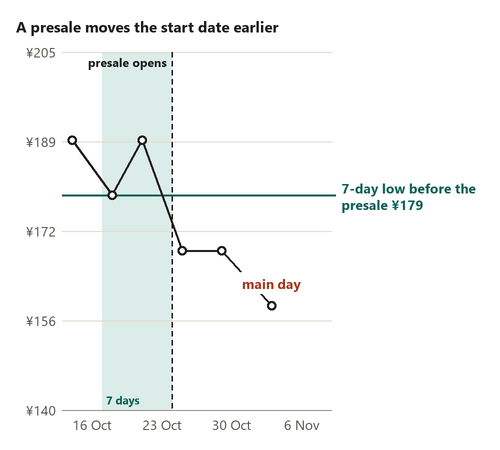
Timing needs care too. Large campaigns on Chinese platforms often open with a presale stage before the main day, so “the start of the promotion” may be earlier than the day the lowest figure appears. If the listing shows a campaign start time, use that as the start date in your record; if it does not, use the first day you saw the reduced price.
Suggested retail prices and how they must be labelled
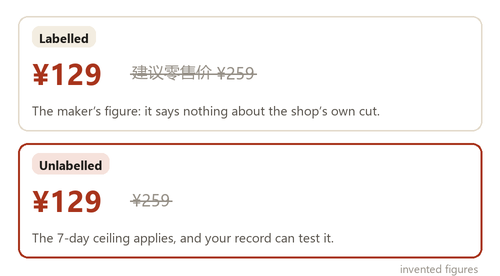
Many boxed goods carry a maker’s price, and listings sometimes strike it through beside the shop’s own price. Article 16 of the 2022 rules allows that comparison, on two conditions: the page must say plainly that the higher figure is a manufacturer’s suggested retail price, and the seller must update it as soon as the maker changes it.
For you the label changes what the comparison can prove. A suggested price is a statement by the maker, not by the shop, so a gap between it and today’s figure says nothing about whether the shop has cut its own price. If the struck figure carries no label at all, Article 16’s seven-day ceiling is the yardstick, and that is one your record can test.
What these rules can and cannot settle for you
These are Chinese administrative rules. They bind sellers in China and are enforced by Chinese market regulators. When an agent buys a listing for you, it buys as a domestic customer, so the listing is covered; you, abroad, are one step removed and rarely in a position to use the rules yourself.
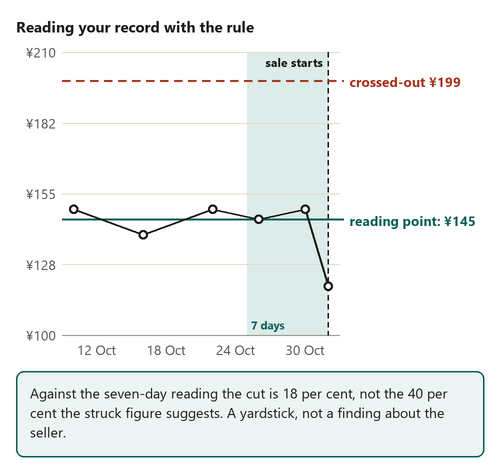
What the rules give you is a yardstick. If a struck figure has no details and sits above the lowest price you saw in the seven days before the sale, the comparison is weaker than it looks, and the reduction you are being shown is not the reduction you are getting. Whether a seller has broken a rule is for a regulator to decide; nothing on this site, including the Look-back chart, is a finding about any seller or legal advice.
For the European and British versions of the same idea, which use a thirty-day yardstick and add tests of duration and volume, see the next page.
Images: catalogue photographs are category examples, not this site’s purchases or verified Mulebuy orders. Drawn material, dimension and lettering examples explain a concept; they do not certify the depicted product.