
Home / EU and UK
The European prior price and the British tests for a was-now claim
Europe defines the old figure in a reduction precisely, and Britain tests it by duration and sales. Both are written for shops selling to European and British buyers, and both make good rulers for a record you keep of a Chinese listing.
Article 6a and the lowest price in the thirty days before
Directive 98/6/EC on price indication was amended by Directive (EU) 2019/2161, which inserted a new Article 6a. Member states had to apply it from 28 May 2022. Its first two paragraphs read:
1. Any announcement of a price reduction shall indicate the prior price applied by the trader for a determined period of time prior to the application of the price reduction. 2. The prior price means the lowest price applied by the trader during a period of time not shorter than 30 days prior to the application of the price reduction.
Article 6a, Directive 98/6/EC as amended, consolidated text on EUR-Lex, read 19 October 2026
Three words carry the meaning. “Applied” covers any price the trader charged, so a displayed price counts even if few people paid it. “Lowest” means the reference is the floor of the period, not its average or its start. And “not shorter than 30 days” sets a minimum, so a member state may not shorten the general window.
The European Commission’s guidance on the article, published in the Official Journal on 29 December 2021 (2021/C 526/02), confirms that a crossed-out display such as “now EUR 50, was EUR 100” is an announcement of a reduction, and that any percentage shown must be worked out from the prior price.
What member states may vary: perishables, new arrivals and stepped cuts
Paragraphs 3 to 5 of Article 6a let each member state make three exceptions. It may set different rules for goods that deteriorate or expire quickly. It may allow a period shorter than 30 days for a product that has been on the market for less than 30 days. And where a reduction is increased step by step, it may let the prior price stay as the price before the first step.
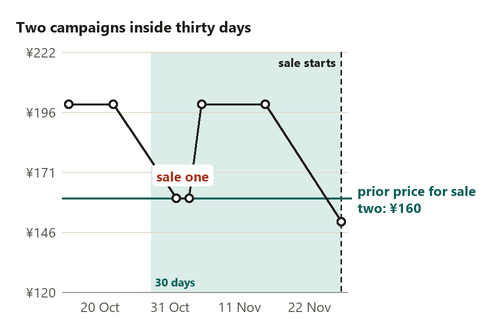
The Commission’s guidance adds a point that matters for Chinese shopping calendars. When sales campaigns follow each other within 30 days, and its own examples name Singles Day, Black Friday and Cyber Monday, the prior price for each new campaign is the lowest price in the past 30 days, which includes the reduced price from the campaign before. A second “sale” cannot reset the old figure to the pre-season price.
Comparisons that Article 6a leaves to the general rules
Not every price claim is a reduction. The Commission’s guidance lists several promotions that sit outside Article 6a and are judged instead under the Unfair Commercial Practices Directive: comparisons with another trader’s price or with a manufacturer’s recommended retail price, and conditional offers such as “buy one, get two”. Long-running loyalty discounts and genuinely personal price cuts are outside it too.
It warns, though, that a comparison with a recommended price must not be presented so that shoppers read it as a reduction; if they do, the display can breach both directives. Online marketplaces that only provide the means for shops to sell are not covered by Article 6a, but the shops selling on them are.
For a crossed-out figure on a Chinese listing, the useful test is the same: if the old figure is a suggested price, it should say so, and it then tells you about the maker, not about the shop’s own price history.
Britain since April 2025: the 2024 Act and trading standards guidance
Britain left the EU before Article 6a existed, so the thirty-day definition does not apply there. Its rules on misleading prices now sit in the 2024 Digital Markets, Competition and Consumers Act, whose consumer enforcement regime came into force in April 2025 and lets the Competition and Markets Authority act directly.
The detailed practice guide is the Chartered Trading Standards Institute’s Guidance for Traders on Pricing Practices, last reviewed in April 2026. It names four kinds of reference price: a was-now price the trader charged before, an after-promotion or introductory price it says it will charge later, a recommended retail price, and another trader’s price. For each sale it asks a short set of questions: how long the higher price was offered compared with how long the comparison runs, whether it was offered in the same outlet, how recently, whether it was an out-of-season price, and whether significant sales were made at it.
On recommended prices it is blunt: their use is contentious, the label must say plainly that the figure is an RRP, and an RRP must be a genuine selling price rather than one set up to make a discount look bigger.
The CMA tests: duration, ratio and volume
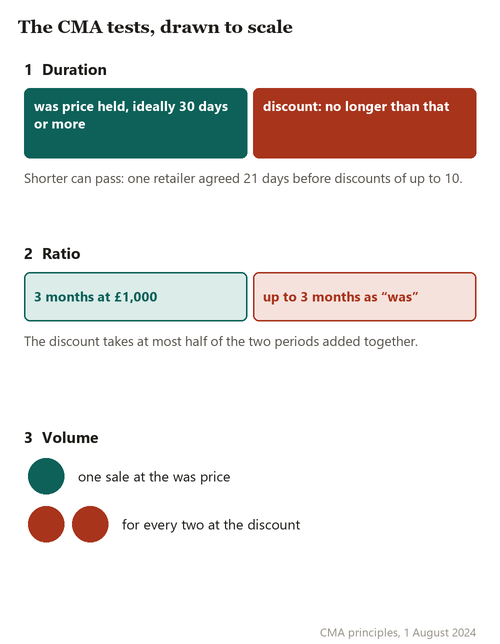
On 1 August 2024 the Competition and Markets Authority published discount and reference pricing principles written for online mattress sellers. It said it would also have regard to them when looking at reference prices in other sectors. They put numbers on the general questions:
- Duration. The was price must be offered on the same website immediately before the discount. Compliance is more likely if it was held for at least 30 days, though a shorter period can be enough depending on the promotion; the CMA cites undertakings from one retailer to hold a price for 21 days ahead of discounts of no more than 10.
- Ratio. The discount period should be no longer than the period the was price was held, so the discount takes up no more than half of the two added together.
- Volume. At least one product should have been sold at the was price for every two sold at the discount.
An earlier open letter from the CMA to online businesses, dated 29 March 2023, gave worked examples of claims it considers likely to mislead: a higher price held briefly compared with a long discount, very few sales at the higher price, prices flip-flopping between two levels, a comparison price followed by lower prices, a short-lived price hike, and an old price from months before. The Look-back chart flags the shapes of several of these in your own record.
Using European and British yardsticks on a Chinese listing
These laws protect buyers in Europe and Britain from shops selling to them. A Taobao or Weidian seller selling to a buyer in China, even when that buyer is your agent, is not bound by them. So do not read a failed test as a legal finding.
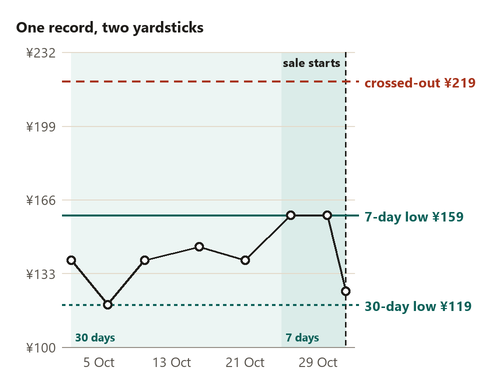
Read it as a sharper ruler. China’s fallback window is seven days and counts sales; the European window is at least thirty and counts any price applied; the British approach adds the length of the sale and the volume sold. A struck figure that clears the seven-day test can still sit well above the thirty-day low, and in that case the saving is smaller than the page suggests on any measure but the shortest.
In practice that means two lines on one record, which is exactly what the Look-back chart draws.
Images: catalogue photographs are category examples, not this site’s purchases or verified Mulebuy orders. Drawn material, dimension and lettering examples explain a concept; they do not certify the depicted product.